Qiaozhi Wang, P.E.
(Prounouced "Chi-ao-Jhi")
Results-driven Professional Engineer specializing in mechatronics, systems integration, and autonomous systems. Demonstrated expertise leading end-to-end development of complex electro-mechanical systems — from concept design through prototype build, validation, and public debut.


Development of experimental setup using Fiber Bragg Grating sensors
Keywords: Solidworks, MATLAB, Computer Vision, 3D printing, Laser cutting, FBG strain sensor
The Biomechanical and Image Guided Surgical Systems (BIGSS) lab at Johns Hopkins University developed a dexterous continuum manipulators (DCMs) which can largely increase the reachable region and steerability for minimally invasive surgery of osteolysis. To enable better real-time tracking and control of DCM, now our team is trying with the Fiber Bragg Grating(FBG) strain sensing technique, which allows us to detect the curvatures of multiple points along the manipulator, and enables reconstruction of the DCM shape.
Design, Manufacturing and Assembly
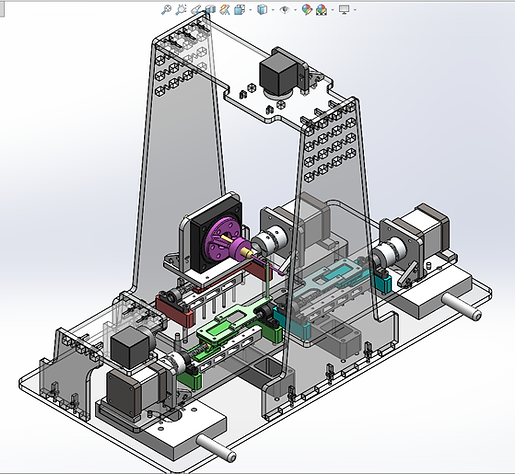

A user interface was developed in MATLAB to enable stepper motors control with Arduinos and 3D reconstruction of needle shape with sensor data in real in MATLAB.
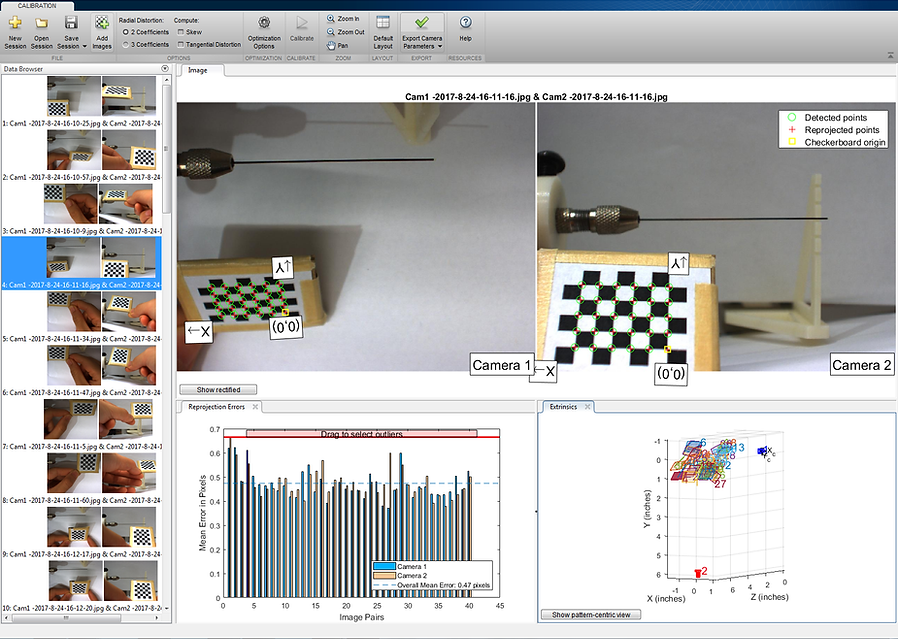
With two stepper motors driving several kinds of obstacles towards the needle from different positions and orientations, FBG sensor data could be collected from interrogator to do the shape reconstruction for each configuration. Then to obtain the “ground truth” shape, calibration for two cameras was performed, which allows 3D detection for needle using stereo vision. Also, a bottom hat filter is implemented to identify the needle from streaming video.
Stereo Calibration in MATLAB